




History
Band on the Wall is ‘a heritage asset in itself and has significant resonance for the Manchester community' – Kate Dickson, Trust Director, Ancoats Building Preservation Trust
Band on the Wall, and its adjacent Picturehouse, are buildings with a rich cultural history. There are deep connections with the old markets and nearby former textile mills, at the heart of the Industrial Revolution. There is, of course, a long tradition of diverse music-making at Band on the Wall, as well as a less well-known history of early 20th century movie shows in the Picturehouse.
Our Archive steadily documents and builds on what is known about this rich cultural background.
The following history was researched by Brian Holmshaw as part of Band on the Wall 25th Anniversary. This research is ongoing and if you have any information, anecdotes, etc, please click on the Links & Volunteers tab (above).
Shouting on Swan Street:
A Short History of the Band on the Wall
Made by the Market
George and Dragon, Band on the Wall, Band in the Wall, Band on the "Wall" at some time in the last 200 years number 25 Swan Street has been all of these. Now an internationally famous music venue, no-one knows when music first started at the Band on the Wall, but market pubs are well known for their musical connections and many Victorian commentators refer to buskers and musicians around the Smithfield market and the streets off Oldham Road.
The first licence for a George and Dragon on Swan Street was granted at the beginning of the 19th century. Remnants from this era still exist in the cellars at the front of the building and can be seen in the layout of some of the internal walls. With land prices at a premium the original George and Dragon would have been some four stories high, and narrow.
At the time Swan Street was a bustling area with a well-established fruit and vegetable market at Smithfield, nearby textile factories, cramped workers housing, a Methodist Chapel and stage coaches running to Ashton-under-Lyne and Royton from the Lower Turks Head in Shudehill.
In 1858 a major development of the market on Goadsby Street at the back of the George and Dragon may have prompted the then licensee Bernard McKenna of Bernard and John McKennas Harpurhey Brewery into making a substantial investment in the pub. The George and Dragon was substantially re-built ' internal doors, pillars, plasterwork and mouldings exist from this period - particularly round the entrance way, in the upstairs offices and above the balcony. A new corner entrance was created and the building lowered to two stories. The McKennas also took over the next door property on Swan Street, creating a wine and spirit merchants shop that sold the products bottled at the McKenna Brewery on Rochdale Road.
By the 1890s the market was booming, trade was good and in 1897 the McKennas effectively doubled the size of the George and Dragon by buying up the next door property on Oak Street. Here they created the huge vault that now serves as the main performance area. They also developed the accommodation side of the business, with lodging rooms and a dining area on the first floor - now used as offices and altered the name to the George and Dragon Hotel.
To be found on Swan Street at this time were William Catchpole's hatting firm; a herring and egg merchant; glass works; coopers; oyster dealer; banks; tobacconist; jewellers; Richardson the pawnbrokers, coffee shops and at number 20 - 22 Swan Street - musical instrument makers. There was also the Rising Sun on the corner of Rochdale Road - a well established public house and music hall, the Burton Arms - still at number 31, and the Smithfield Hotel at the end of the row.
Photograph of Swan Street, 1900, credit: Manchester City Libraries, local history unit
How the Band on the Wall got it's Name
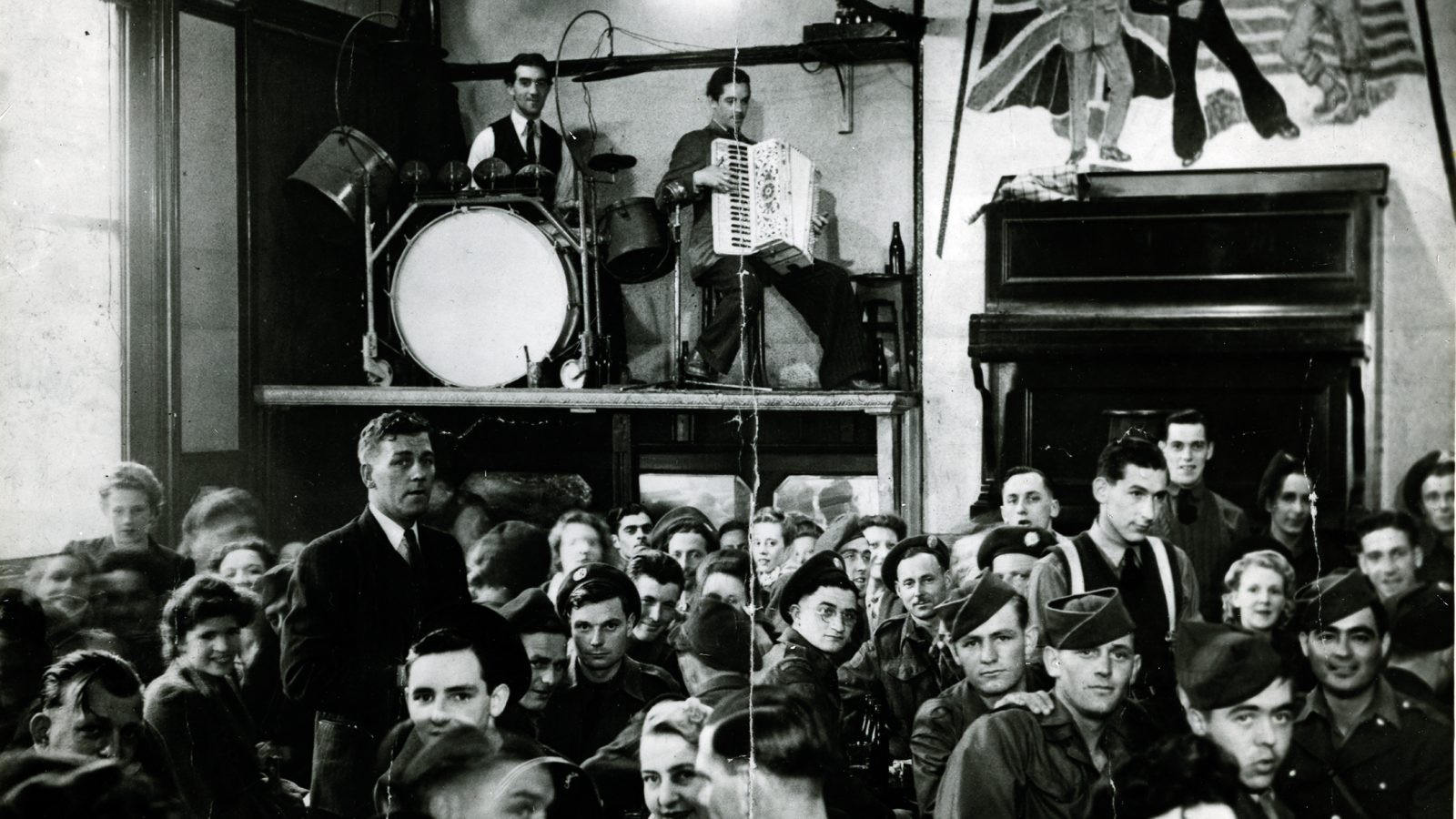
Almost everyone knows that 'The Band' got it's name because of the small stage high up on the wall that musicians used to perform on. But finally we can reveal how this came about. Florrie Branagan and Jack Branelli - who later married - and who played at the George and Dragon in the late 1930's, remember that the idea for a stage upon the wall came from Ernie Tyson Flo's uncle - in 1937, and that he installed the stage.
A regular band of two accordionists, piano, drums, singer and sometimes saxophonist would play. Key performers were Flo Branagan (accordion and singer), Jack Brannelli (accordion), Jim Hart on drums, Saxophone Mick the Pole and Albert Mancini on piano. Italian accordion wizard Rudi Mancini, and the 'Elvis of Ancoats' Dominic Rea also played accordion at the Band on the Wall. Lawrence Kelly a fish merchant in the market played cornet. Floor singers sang in front of the piano or in front of Flo. There was no amplification and contrary to rumour there were steps up to the stage, not a ladder! Bands played 7.30pm till closing time with a couple of breaks, six nights a week.
Always known as a rough place Ernie Tyson ran it with a rod of iron. Jack Branelli remembers that if there was any trouble 'one punch from Ernie and they'd be on the cabbages' - a reference to the vegetable stalls that lined Oak Street.
The George and Dragon had table service and the waiters wore white aprons. It was immensely popular and known as a services pub during the war when Americans, Canadians, Australians, French as well as British soldiers, market traders, factory workers and shoppers all used it. Italian prisoners of war and deserters were rumoured to come in. Often the band carried on playing during air-raids ' especially when the raids became more common.
Many boxers used the saloon bar at the back - Jack Branelli remembers Jackie Brown the world flyweight champion from Harpurhey. There were also the gangs 'the Hamilton gang from Angel Meadow including Jazzer Hamilton' considered a dangerous character to cross - but who once dueted on a love song with Flo Branagan
Photograph of Flo and Jack, circa 1942, credit: Flo, Jack and Gina Branelli
Re-birth
By the middle of the twentieth century Swan Street was in decline. Many textile factories had closed and people moved out of the area. Market trade was down and the buildings were demolished in the early 1970s. The fortunes of the George and Dragon - or Band on the Wall as it was increasingly becoming known ' mirrored this slump. Drag acts such as Diamond Lil and Neville St Claire were popular in the late 1950s, but by the mid-1970s the George and Dragon was on its last legs.
Photograph of George and Dragon '1959' credit Manchester City Libraries, local history unit
It was at this point that Steve Morris, saxophonist, jazz fan and entrepreneur moved in with a bold idea to develop the old George and Dragon as a jazz venue. A discussion with Johnny Roadhouse persuaded him to stick with the name Band on the Wall and along with partner Frank Cusick he took a lease on the pub and re-opened in 1975.
Jazz and blues in the early days included a mixture of established names and up-and coming local and national musicians seen today, and included No Mystery, Norman Beaker, Gags and piano player Joe Palin.
The Punk explosion happened in the late 1970s. Mondays soon became known as New Manchester Review nights providing a focus and support for a local political and music magazine of the time. Bands who played under this title included John Cooper Clarke, The Passage, A Certain Ratio, Joy Division (who played the night they first got a syn-drum) The Fall, Buzzcocks, John the Postman and The Distractions. Mark E Smith of The Fall was a strong supporter of the Monday night venture. Big In Japan played on Monday 13 February 1978 and whilst the name is not so well known they included future well-known musicians Jayne Casey (of Cream nightclub, Liverpool), Ian Brodie of The Lightning Seeds, Holly Johnson of Frankie Goes to Hollywood and Bill Drummond, manager of the Teardrop Explodes and later a member of KLF.
Photograph of George & Dragon circa 1970s
The 1980s
1982 saw a brief shut-down and re-opening due to a buy-out by the Northern Branch of the Jazz Centre Society. There was also some internal redevelopment work. The saloon bar was now altered to a wooden raised platform making use of a job-lot of tables and seating apparently from an old Burger King restaurant in Northenden!
1982 also saw the first use of the Dizzy Gillespie logo, real ale installed and a regularly printed programme of events was put out. The re-opening gig was from The Distractions. Other performers that year included Alexis Korner, John Peel, Kevin Coyne, Melvyn Poore, 'solo tuba and tapes', Don Weller, P.M.T. and Electra Complex ' part of the Women in Entertainment night, The Fall ' three nights on the 3, 4, 5 May with Icelandic support band Purkur Pillnikk (featuring a young Bjork on vocals), Southern Death Cult - who ended up as stadium rock band The Cult, Albertos y los Trios Paranois, Gordon Giltrap, Nico - three nights on 6,7,8 September, Michael Nyman, Slim Gaillard, Lol Coxhill, Steve Lacey and Keith Tippett, Jimmy Witherspoon and Prince Far-I.
In 1987 the balcony was installed, and in 1991 founder of the new Band on the Wall Steve Morris died after a long illness.
The 1990s
The last decade has seen a greater concentration on quality jazz performers at the Band on the Wall. There has also been an increasing emphasis on bringing out new young talent through the Well North of London rock showcases and a growing programme of Inner City Music workshops and outreach work.
MORE HISTORICAL INFORMATION TO FOLLOW


